← Back to geotechnicalengr.com
Personal Project
SPT Liquefaction
A desktop tool that runs liquefaction triggering and settlement analyses from SPT data. I built it to learn the published methods by implementing them line by line.
A desktop tool that runs liquefaction triggering and settlement analyses from SPT data. I built it to learn the published methods by implementing them line by line.
Liquefaction triggering and settlement analysis rests on several published procedures that don't always agree, and it's easy to run them through software as a black box. I wanted to understand the methods from the inside — every equation, coefficient, and judgment call — by implementing them myself.
A Windows desktop tool, packaged as a single program that runs with a double-click — no install, no Python needed on the machine. You enter soil units and SPT data by hand, and it runs liquefaction triggering by Idriss & Boulanger (2010), Cetin et al. (2004), and Youd et al. (2001), plus post-liquefaction settlement by Cetin et al. (2009), Ishihara & Yoshimine (1992), and Tokimatsu & Seed (1987). Fine-grained soils are screened first, and soils that behave like clay are flagged as outside the SPT method instead of being run through it.
Every equation was transcribed from the source papers with page citations, rather than rebuilt from memory, because coefficients and errata vary between editions. Where the papers disagree — the depth limit on the stress reduction factor, for example — it's a setting you can change, not a hidden choice. Results show each calculation stage by depth, alongside six side-by-side depth profiles: blow count, soil log, CRR and CSR, factor of safety, actual versus required corrected blow count, and settlement.
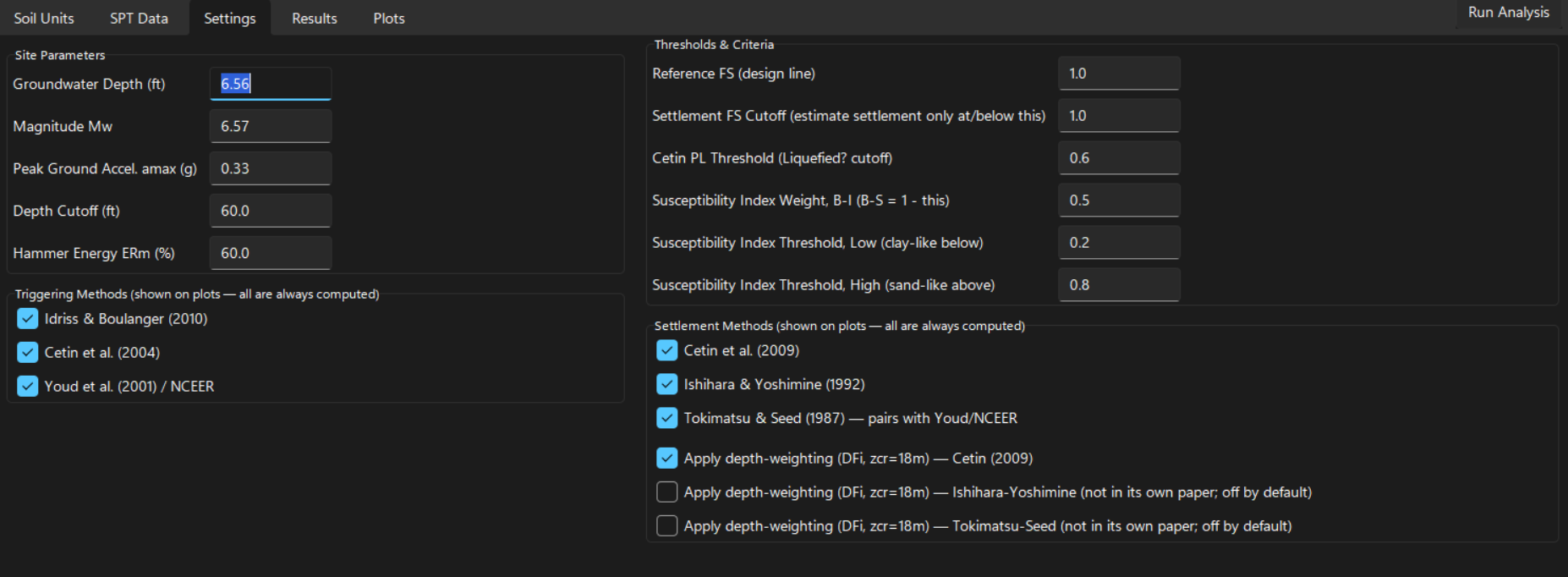
The Settings tab: site parameters, thresholds, and the methods being compared. Judgment calls are visible settings, not buried defaults.
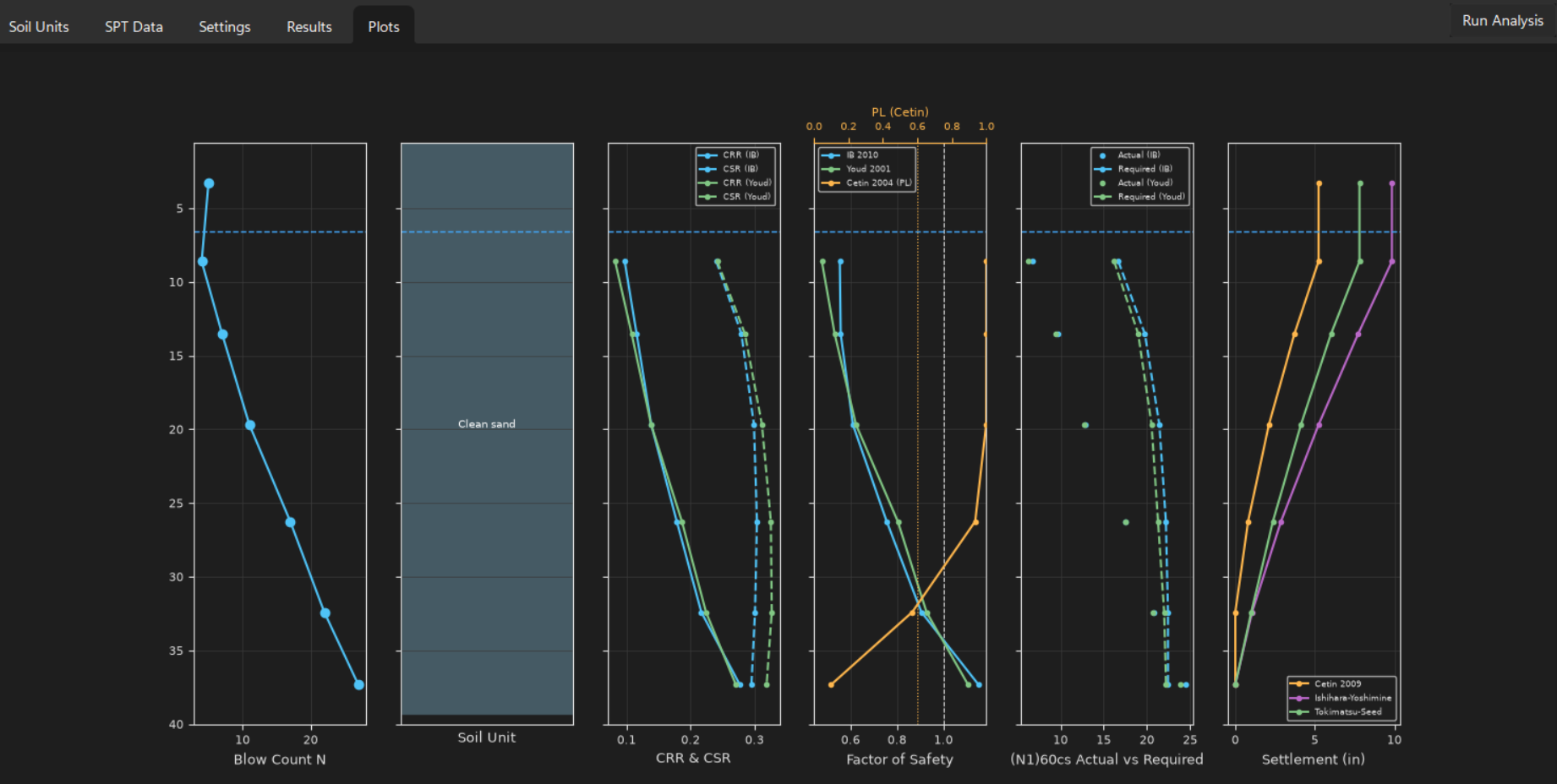
Six depth profiles share one axis, so you can see where the methods agree and where they diverge. Shown here with a public example profile.
A working tool that shows its work, and a much firmer grasp of where these methods agree and where judgment enters.